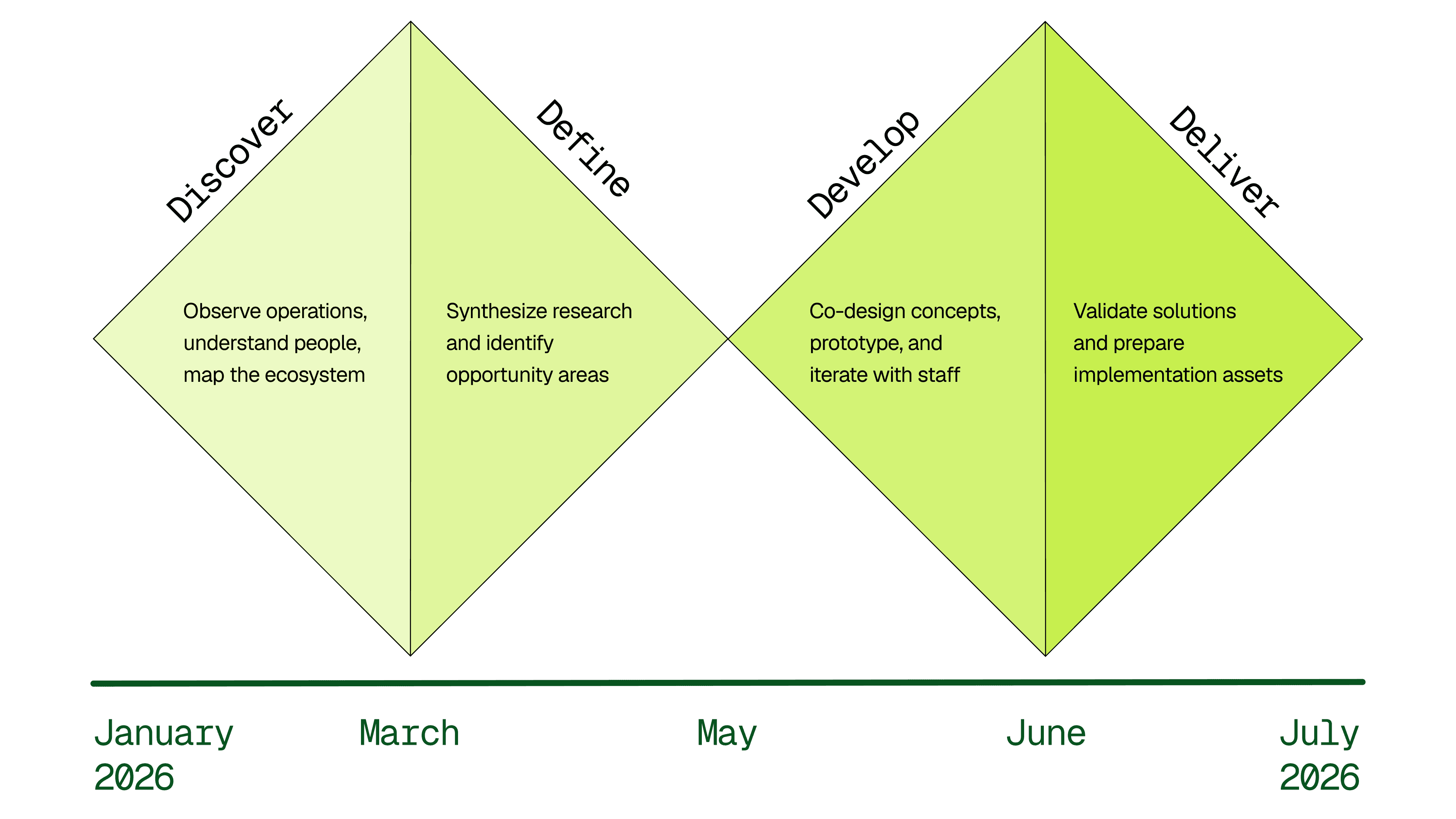
For seven months, our team partnered with Pittsburgh nonprofit Construction Junction to rethink how donated inventory moves from the warehouse to the retail floor. I led as Product Manager and helped turn months of field research into working prototypes now moving toward implementation.
My role
Product Manager
Timeline
January to July 2026
My team
1 product manager (me!)
2 product strategists
2 designers
Client
$30K implementation funding

The Challenge
Construction Junction couldn't reliably track what was in its inventory.
An understaffed team, constant interruptions, and inefficient workflows left little time to consistently document and review inventory. Over time, those inconsistencies made it harder to understand what CJ actually had, make informed decisions, and share reliable information with customers.
"We’re getting slammed with pallets of donations, and...I need to get this [item] in now, like right now. There’s no time to even make a second judgment call."


The Solution
Improving inventory quality at intake strengthens pricing, inventory management, online merchandising, and customer discovery across the organization. Early results reinforced this potential: CJ Studio A/B testing generated 5.5× more link clicks and significantly increased reach and engagement, while Construction Junction secured $30,000 in funding for future implementation.
01
Designed around the donation workflow
We reorganized the experience to match how staff actually process donations. The new flow guides staff from donor information to item type, photos, and key details in the order they naturally need them.


02
Designed to reduce cognitive load
We simplified each screen so staff can quickly see what they need to do next. Related actions are grouped together, required fields are easier to spot, and item names are automatically created from information staff already enter.


The Process
We started with a much broader question around how Construction Junction could better reach customers and support its mission. But interviews, survey data, and time spent observing staff on the donation dock pointed us toward a less visible problem: the systems behind the scenes were slowing people down.
Staff might process a stove, bathtub, conference table, and lumber within minutes, and each donation could require a different sequence of decisions. During one observation, we watched staff manage 11–12 interruptions in under an hour while only three items were labeled in 42 minutes.
20+
Staff & stakeholder interviews
14
Interruptions every hour
17%
Of intake fields used by staff